1670 – 1950 · A woodblock print is a committee, a commodity and a picture

浮世絵UKIYO-E

Pictures of the floating world. For two and a half centuries Japan printed its celebrities, its weather, its gossip and its ghosts onto paper with a knife, a cherry plank and a pad of bamboo sheath — and then sold them for the price of a bowl of noodles.

35 plates · 9 museums Every image public domain or openly licensed Scroll for the deep cut

scroll
一

The word arrived before the pictures

Uki · yo · e — floating, world, picture

The phrase was a pun, and the pun was a whole philosophy. Buddhism had given Japan — ukiyo, the sorrowful world, the vale of tears you endure before the next life. Sometime in the seventeenth century, as the country settled into two centuries of enforced peace, someone re-heard those syllables and wrote them differently: , the floating world. Same sound. Opposite diagnosis. Not a place to escape but a place to enjoy, because it will be gone by morning.

“Living only for the moment, turning our full attention to the pleasures of the moon, the snow, the cherry blossoms and the maples; singing songs, drinking wine, diverting ourselves in just floating, floating; … refusing to be disheartened, like a gourd floating along with the river current: this is what we call the floating world.” Asai Ryōi, Tales of the Floating World (Ukiyo Monogatari), c. 1661

Asai Ryōi was writing prose, not art criticism, but he wrote the brief for an entire industry. Ukiyo-e — , "pictures of the floating world" — is what happens when a city decides that the ephemeral is worth depicting: the kabuki star in a striking pose, the famous courtesan, the tea house, the fireworks at Ryōgoku, a shower over a bridge, a wave about to land on eight rowers who cannot stop it.

Two things about that word matter for everything below. First, the subject is the present: not gods, not ancestors, not the Chinese classics — the street. Second, the subject is disposable. These were consumer goods with the moral weight of a poster. That low opinion is precisely why the pictures got to be so free: nobody guarding the gates of high art was watching the people making them.

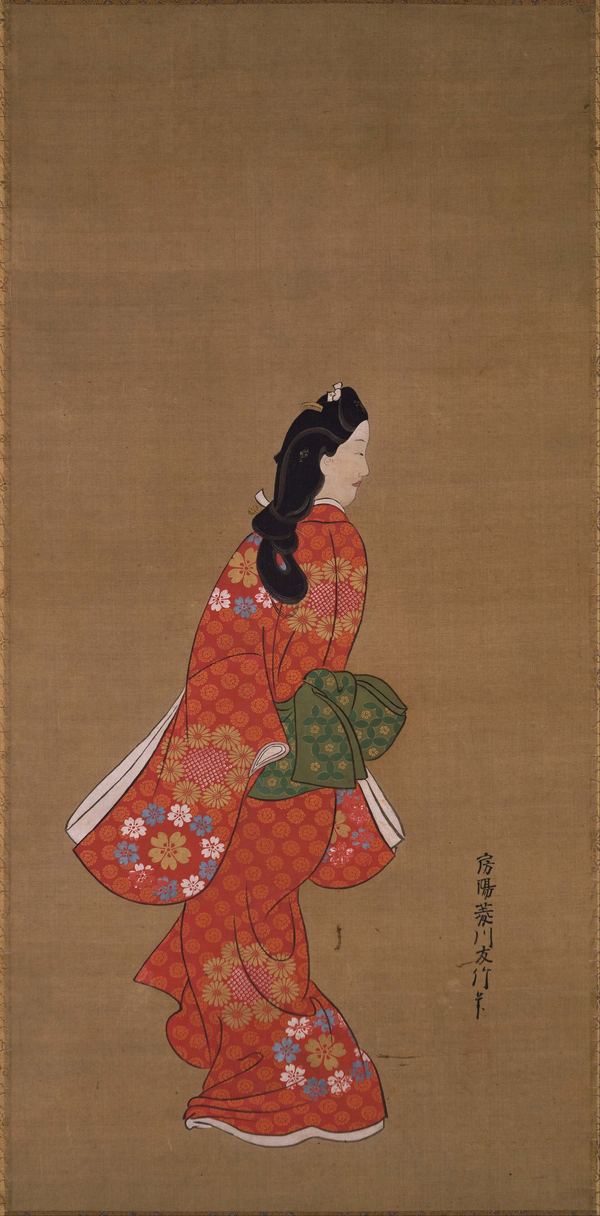
Hishikawa Moronobu, Beauty Looking Back: a woman in a red patterned kimono, head turned, against an almost empty silk ground.
plate 01Beauty Looking Back Hishikawa Moronobu · late 17th century · hanging scroll, ink and colour on silk

The founding image of the genre, and it is barely there. Almost the whole sheet is empty — silk, a little gold, unmodulated. All the drawing is in the turn of a neck: the body walks one way, the head has already gone the other. Moronobu (c. 1618–1694) is the artist to whom ukiyo-e is conventionally traced: from the 1670s he was painting and printing women of the pleasure quarters while everyone else was still illustrating poems. Note this is a painting, not a print — the earliest ukiyo-e had to be unique before it could be cheap.

A genre, not a school. There was no academy, no manifesto, no doctrine of ukiyo-e. There were publishers with a catalogue to fill, artists with a deadline, and an audience with money and an appetite for pictures of itself.
二

The city that wanted pictures of itself

Edo · the chōnin · the licensed quarter · the stage

When Tokugawa Ieyasu made Edo the seat of his shogunate in 1603 it was a fishing village with a castle. Within a century it was the biggest city on earth, and the class that made it rich — chōnin, merchants and craftsmen, officially ranked near the bottom of the Confucian order — had cash to spend and no land, no titles and no prospects of either. So they spent it on the only immortality available to them: being depicted.

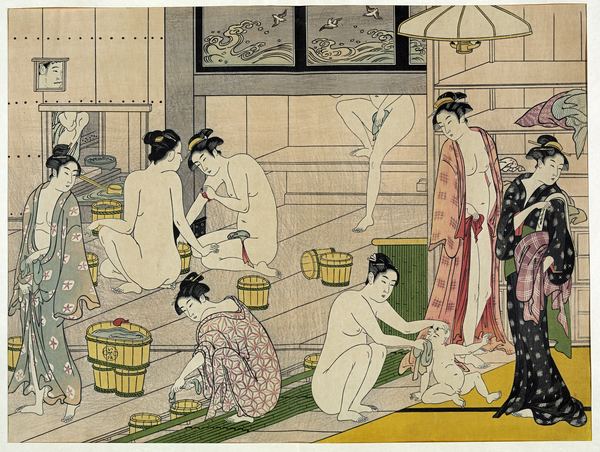
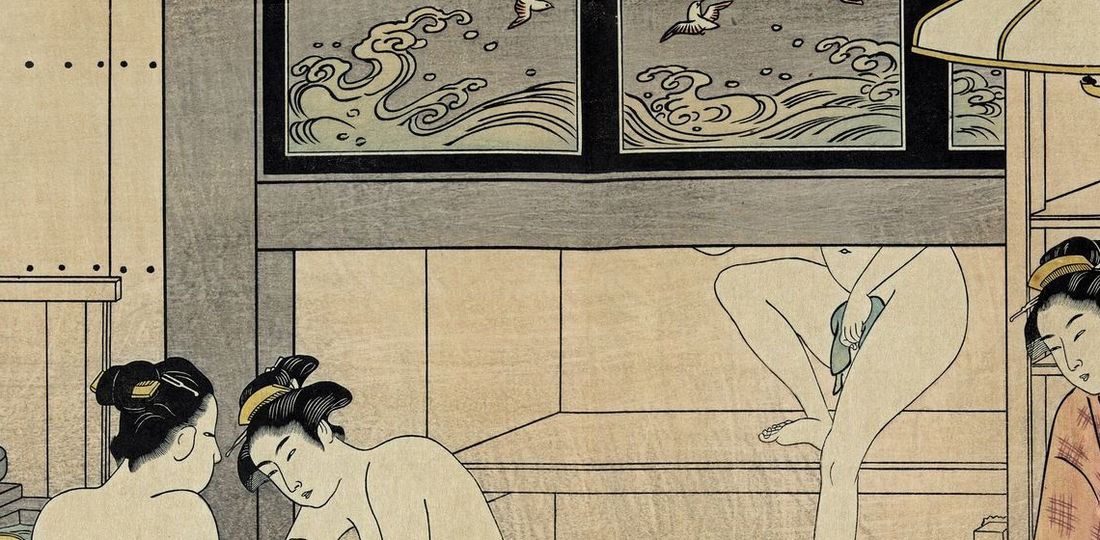
Torii Kiyonaga, Women at a bathhouse: about ten figures washing, dressing and minding a baby in a wooden bathhouse with a wave-carved transom.
plate 06Women at the bathhouse Torii Kiyonaga · after 1780 · diptych of woodblock prints, two sheets joined

Kiyonaga (1752–1815) was the pre-eminent painter of beauties in the 1780s, and his speciality was the tall, unhurried, full-length figure — young women with the proportions of a fashion plate, arranged across a room with the casual geometry of a photograph. Two sheets joined here, and a seam runs straight down the middle of the room; you can see the floorboards shift. Everyday labour, rendered with the seriousness a European painter would have reserved for a coronation.

Two engines: the quarter and the stage

Ukiyo-e's two great commercial subjects were the Yoshiwara and the kabuki theatre. Both sold fame by the picture: a courtesan's portrait, a playbill, an actor's likeness on the wall of a shop selling cosmetics or grilled eel. The Yoshiwara and the theatre district were the city's media, and ukiyo-e was their advertising, reportage and fan culture at once.

Star portraits before the word existed

Actor prints — yakusha-e — were the first mass star merchandise. The Torii school, from Kiyonobu in the 1690s, printed theatre bills and actor portraits; buyers collected them by role and clipped them into albums. Later, Sharaku would make the likeness so uncomfortably real that, by contemporary report, the public preferred the flattery of the past.

A wooden city, always burning

Edo was paper and pine. Fires, earthquakes and rebuilding were constant; prints recorded all of it. That instability is the other half of the "floating world" — the pictures of the pleasure quarter and the pictures of a drowned city come out of the same presses.

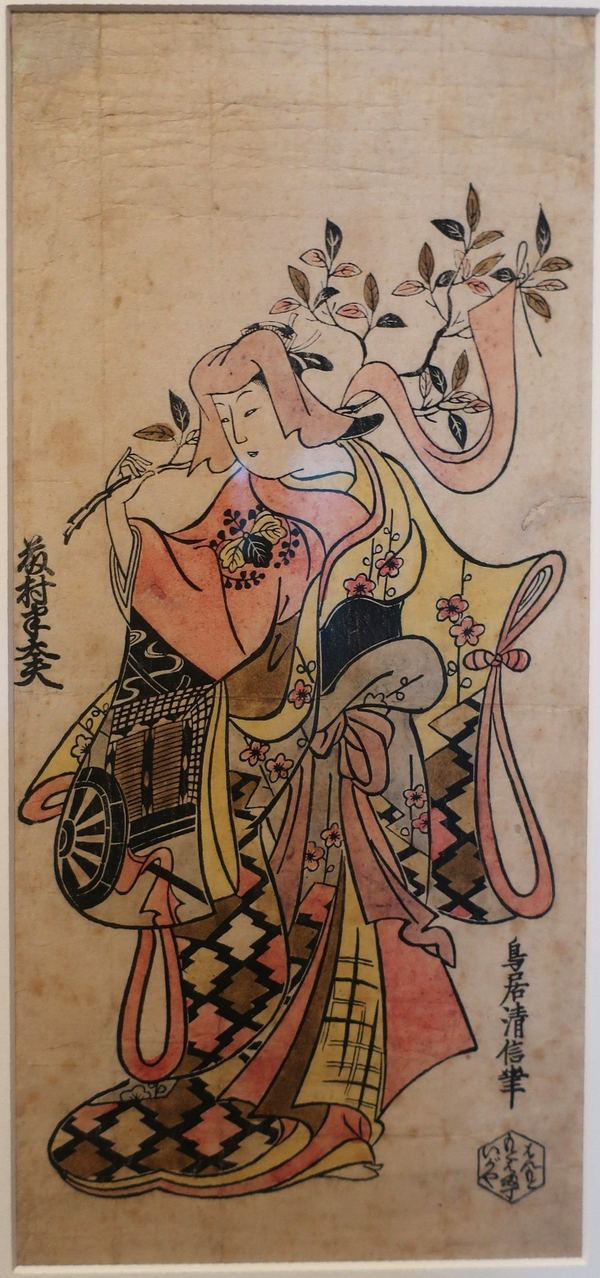
Torii Kiyonobu I, Kabuki actor Fujimura Handayū II in a hosoban-format print, brush-applied colour over a monochrome keyblock.
02The actor Fujimura Handayū IITorii Kiyonobu I · late 1710s · woodblock print with colour applied by hand, Honolulu Museum of Art
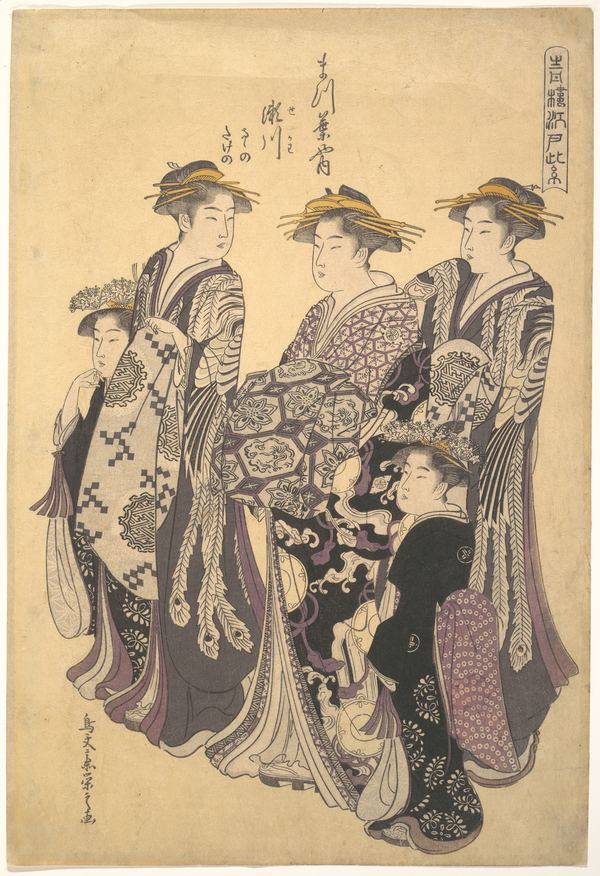
Hosoda Eishi, a group of courtesans and two small attendant girls against a blank ground, with a cartouche naming the pleasure quarter.
08Courtesans and attendants Hosoda Eishi · c. 1780s–90s · woodblock print, The Metropolitan Museum of Art (CC0)

No street, no teahouse, no background at all — just figures and blank paper. The cartouche reads seirō, "pleasure quarter": the quarter is named, not shown. High-ranking courtesans wore the tall clogs and the trailing ropes of hairpins; the small figures are kamuro, their apprentices.

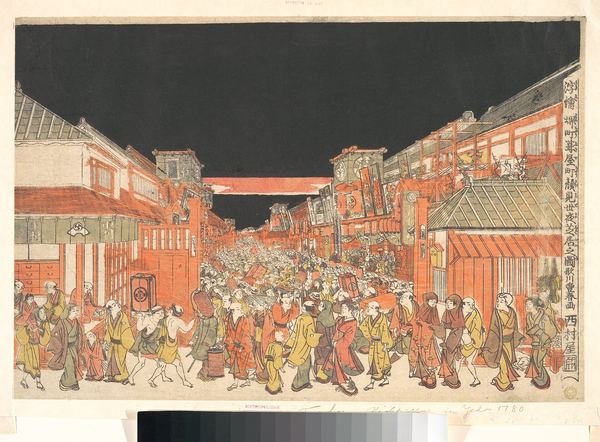
Utagawa Toyoharu, perspective view of the kabuki theatre district at dawn on opening day, with crowds, banners and buildings receding to a vanishing point.
05The theatre district at dawn Utagawa Toyoharu · 1770s · uki-e, woodblock print, The Metropolitan Museum of Art

Caught between two worldviews: an Edo crowd painted with a European vanishing point. Japanese artists got perspective through imported Dutch prints and reasoned out the rest — and publishers sold it as a novelty called the "floating picture".

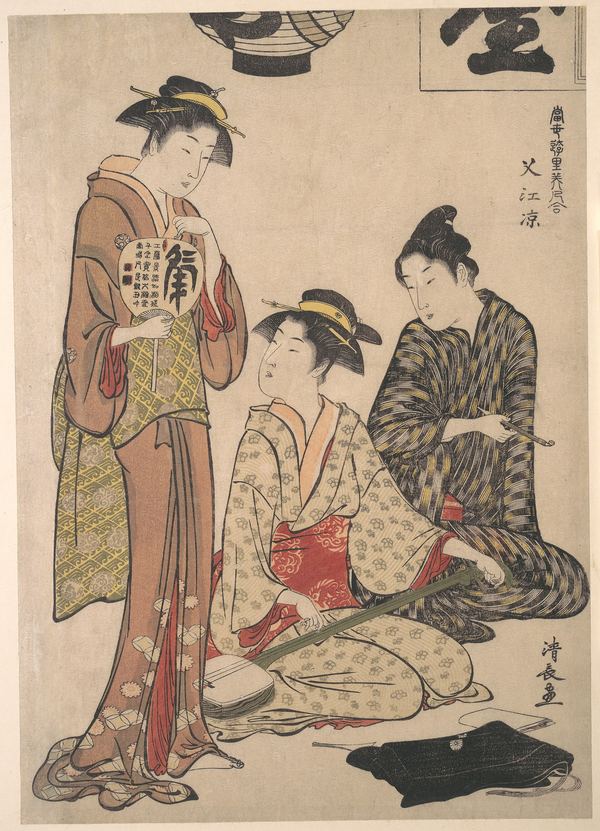
Torii Kiyonaga, elegant women taking the evening cool on a balcony over the water at Nakasu.
07Cooling off at NakasuTorii Kiyonaga · c. 1782–83 · woodblock print, The Metropolitan Museum of Art (CC0)
三

Four hands, one image, one plank per colour

Eshi · horishi · surishi · hanmoto

Nothing in ukiyo-e was made by one person. An artist designed it, a carver cut it, a printer pulled it, and a publisher financed it — chose the subject, set the budget and owned the finished woodblocks, which was the closest thing to copyright the period had. The artist only rarely touched a knife or a brayer.

A run through the press, layer by layer. This schematic is mine, not a museum plate — I drew it to show how the process stacks, because a real print's separations survive only in the blocks. Switch the layers and watch the picture assemble the way a printer would build it: keyblock first to fix the drawing, then flat colour, then the finishing tricks.

The sequence, from drawing to print

  1. Hanshita-e — the finished design, drawn in ink on thin paper.
  2. Pasted face-down on a plank — smooth cherry was preferred; the paper is wetted and rubbed until the ink transfers.
  3. Cut — the carver incises both sides of every line and gouges away the rest, leaving the drawing in relief.
  4. Registered — kentō marks are cut at one corner and along one adjacent side, identical on every block.
  5. Inked with water-based pigment — brushed onto the raised surface, one block per colour. A finished nishiki-e might use five to ten blocks; the Met's conservators put the practical ceiling near twenty.
  6. Printed by hand — paper laid on wet pigment and rubbed from the back with the pad, the baren. A good printer could pull a couple of hundred sheets a day, teasing a soft gradient out of a flat block as they went.

That gradation is bokashi — colour wiped into the block before the paper goes down. It is the reason Japanese skies breathe while a European woodcut's don't.

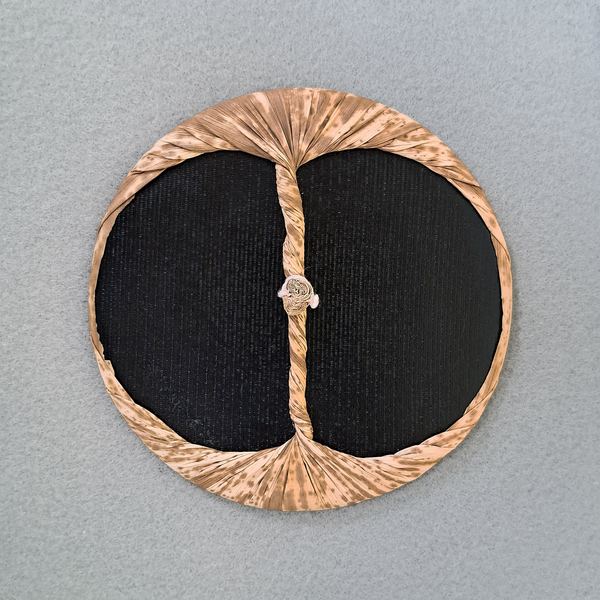
A baren: a disc of layered paper wrapped in bamboo sheath, with the twisted sheath forming a cord handle across the centre.
34The baren Photograph: Tiouraren (Y.-C. Tsai), CC BY-SA 4.0, via Wikimedia Commons

No press, no roller, no cylinder. A disc of coiled paper wrapped in the thin sheath that peels off a bamboo stalk, with the ends twisted into a handle. The printer grips that cord and rubs. Everything in ukiyo-e — the deep indigo, the whisper of a sky gradation, the mica glitter — was pressed through paper by a human forearm.

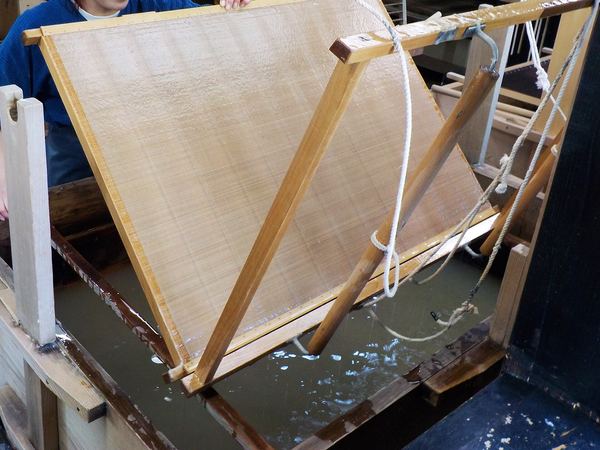
Paper-making: a craftsman lifting a screen of wet kozo fibre from a vat of water.
35Washi Photograph: TR15336300101, CC BY-SA 4.0, via Wikimedia Commons · Udatasu craft hall, Echizen, Fukui

The substrate is a technology in itself: sheets beaten from the inner bark of the paper mulberry, long-fibred enough to survive fifteen trips onto wet wood without tearing, absorbent enough to take a water-based pigment instantly. Print on ordinary rag paper and the whole method collapses.

What it cost, and how big it was

Full-colour prints settled at 16 to 32 mon — an everyday purchase, which is the single most important technical fact about ukiyo-e. This was not an art market. It was a print industry whose economics rewarded speed, novelty and the ability to sell the same face a hundred different ways.

The blocks stayed in the publisher's warehouse, and were reprinted when a series sold. Wear shows: lines thicken, colour blocks choke, a crisp early impression and a tired late one can be the same design fifteen years apart. Two decades of reprinting is why the "same" print in two museums can look like two different works of art.

ōban≈38×26 cm
chūban≈26×19
hosoban≈32×15
hashira-e≈72×12
tanzakupoem slip

Sizes are approximate standard formats, drawn to relative scale. Ōban carried the great landscapes; hosoban was the actor's format; the hashira-e was made for the pillar of a house, a picture you walked past.

四

Four hundred years, in fourteen stops

Drag the strip · it runs from 1670 to 1950

Every shift in ukiyo-e was either a technical breakthrough or a crackdown. Colour arrives in 1765 when a carver solves registration. Landscapes arrive in the 1840s because the government bans pictures of actors and courtesans. Follow the strip sideways.

drag or scroll sideways

1670s–1690s

Women, in black and white

The genre starts as illustration. Hishikawa Moronobu publishes monochrome prints and illustrated books — pictures of the pleasure quarters, sold as pages and sheets. Ink on paper, nothing clever, everything new: the subject is the street.

Hishikawa Moronobu · Sugimura Jihei

1690s–1720s

The stage gets a portraitist

Torii Kiyonobu prints kabuki playbills and actor portraits, and invents the star system in paper. Colour isn't printed yet — it's brushed on by hand, one sheet at a time, in orange-red and a lacquer-like black.

Torii Kiyonobu I · Torii school · hand-coloured urushi-e

Torii Kiyonobu I, actor print with hand-applied colour, tall hosoban format.
Kiyonobu I, the actor Fujimura Handayū II, late 1710s. Honolulu Museum of Art (CC0).
1700s–1740s

Perspective, pillars and lacquer

Okumura Masanobu works every angle at once: tall pillar prints for hallways, glossy black lacquer effects, and uki-e perspective pictures reasoned out from Dutch imports. By the 1740s he is using several blocks to lay down colour rather than painting it on.

Okumura Masanobu · Torii Kiyomitsu · Ishikawa Toyonobu

1740s–1764

Two colours and an ambition

The benizuri-e: pink and green printed from two or three blocks. It is a compromise, and everyone knows it. The race is on to print a whole spectrum without the paper buckling.

Ishikawa Toyonobu · Torii Kiyomitsu · Kitao Shigemasa

1765the breakthrough

Brocade prints: colour without hand-painting

The first full-colour prints are commissioned New Year calendars, given as gifts by a circle of wealthy Edo patrons — the printer's art hidden inside a puzzle, where the calendar's numbers are buried in the picture. The carver credited with the registration precision that made it possible is Kinroku; Suzuki Harunobu supplies the taste, trading catalpa for cherry blocks and building up to ten colours on one sheet. Within five years he is dead at 46, and full colour is the industry standard forever.

Suzuki Harunobu · carver Kinroku · nishiki-e

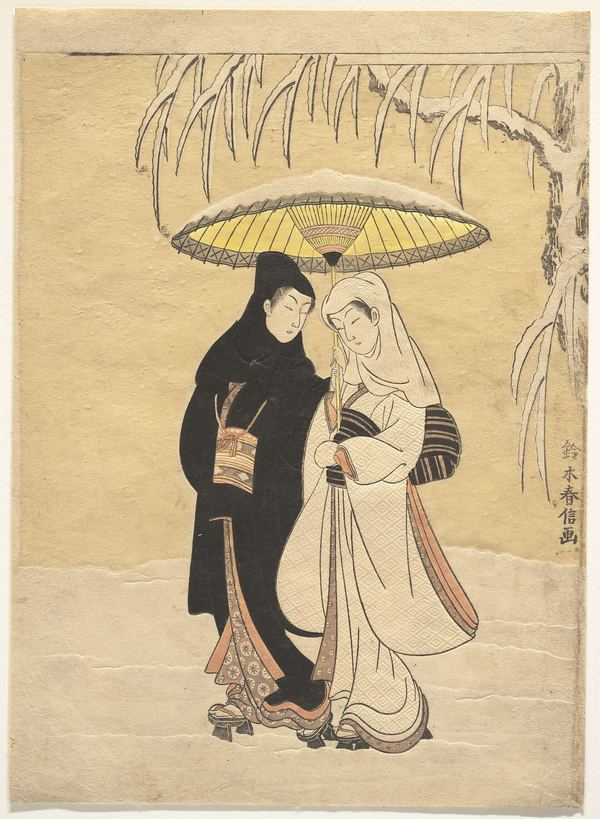
Suzuki Harunobu, two figures sharing one umbrella in the snow, in a restrained palette of black, white, cream and gold.
Harunobu, lovers walking in the snow, c. 1760s. Restrained palette, blind-embossed white — luxury printing sold at a street price.
1770s–1780s

The tall beauty and the big head

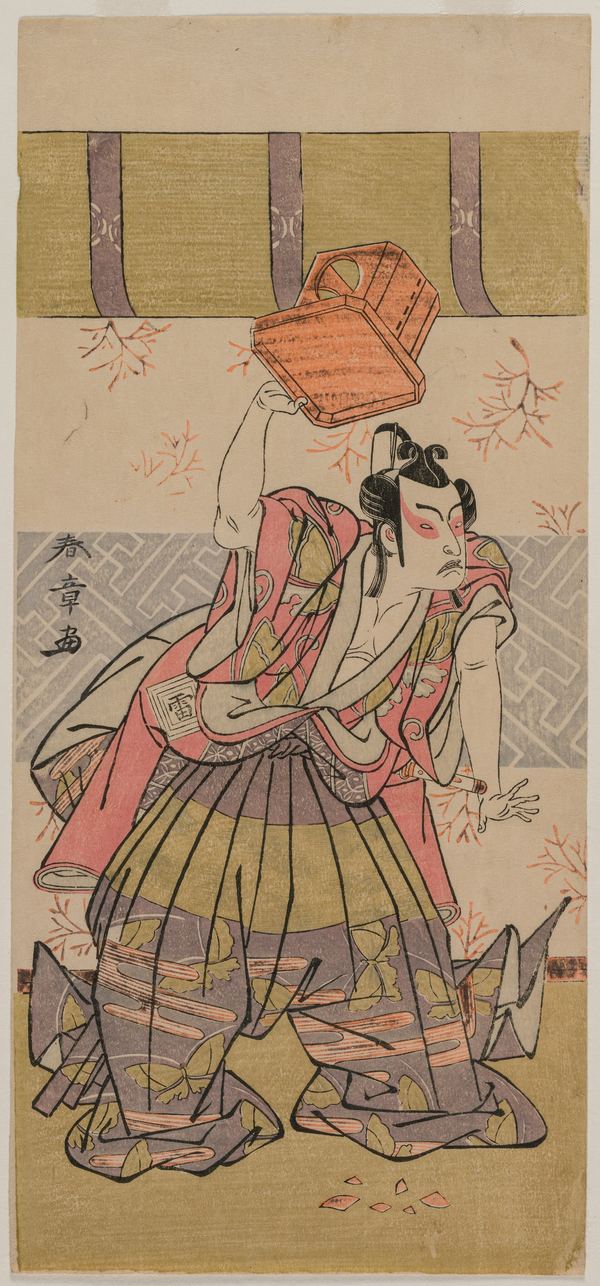
Torii Kiyonaga draws women at full height — nine heads tall, walking, arranged across a room like a fashion spread. Meanwhile the Katsukawa school invents the ōkubi-e, the head-and-shoulders portrait, first for actors, dusted with mica so the background glitters behind the face.

Torii Kiyonaga · Katsukawa Shunshō · Katsukawa Shunkō

Katsukawa Shunshō, actor portrait in tall narrow format, the figure holding a drawn sword.
Katsukawa Shunshō, the actor Ichikawa Raizō II as Soga no Gorō, mid-1770s. Cleveland Museum of Art (CC0).
1790sthe peak

The decade of the face

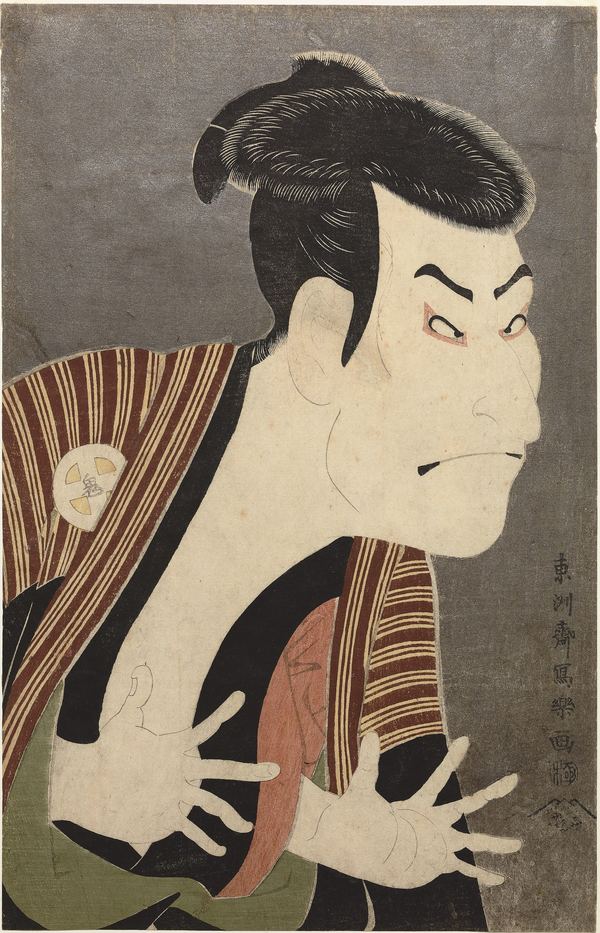
The single greatest run of portrait prints in Japanese art, squeezed into ten years. Kitagawa Utamaro isolates the beauty's head and fills the sheet with it — hairline, brush, collar, nothing else. Tōshūsai Sharaku appears out of nowhere and produces over 140 actor portraits in ten months, showing the men as they probably were: thick necks, scowls, eyes crossed in a mie. The public finds the truth harder to like than the flattery, and Sharaku's career stops in the first month of 1795. His identity has been argued about ever since.

Kitagawa Utamaro · Tōshūsai Sharaku · Chōbunsai Eishi · Utagawa Toyokuni

Sharaku, the actor Ōtani Oniji III as Yakko Edobei: a heavy-jawed man in a striped robe, fingers splayed like claws, against a dark mica ground.
Sharaku, Ōtani Oniji III as Yakko Edobei, 1794. Tokyo National Museum.
1804–1806

The artist in manacles

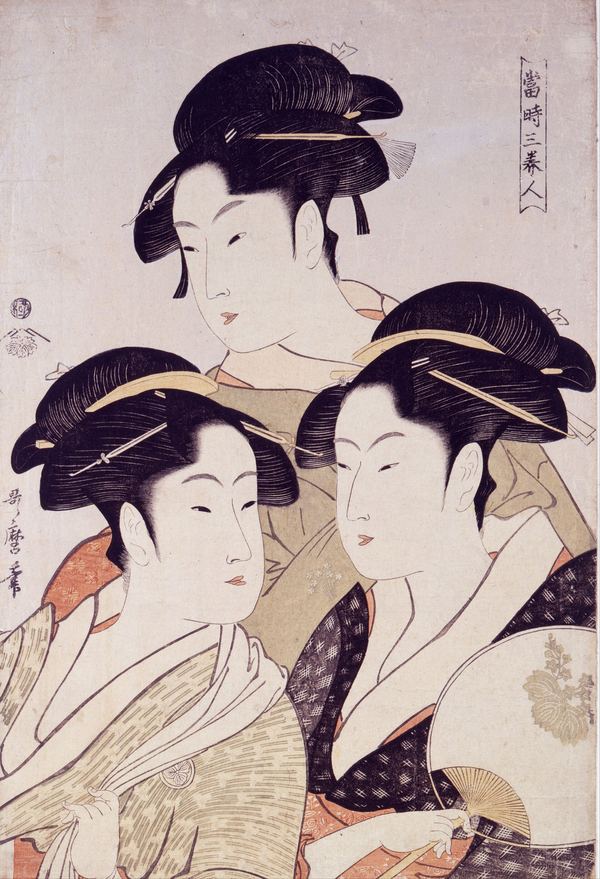
Kitagawa Utamaro, who produced over 2,000 known prints and was one of the few ukiyo-e artists famous across Japan while alive, is arrested and manacled for fifty days over prints depicting the sixteenth-century ruler Toyotomi Hideyoshi — a sensitive subject for the shogunate. He dies in 1806. His great patron and publisher, Tsutaya Jūzaburō, had died nine years earlier; by most accounts the work lost its nerve after that.

Kitagawa Utamaro · publisher Tsutaya Jūzaburō

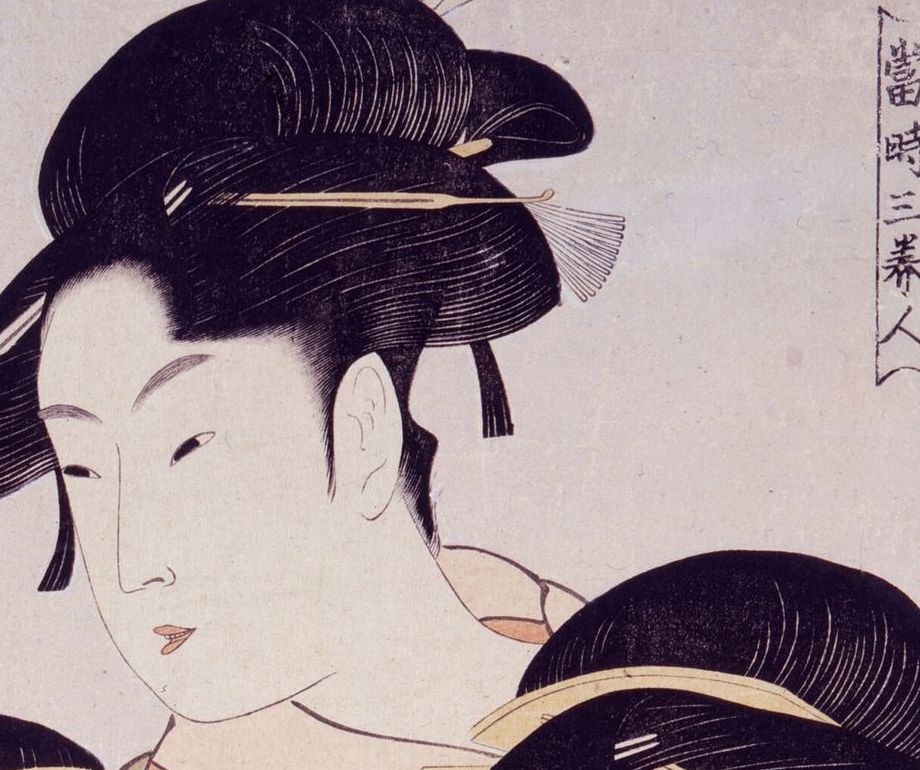
Utamaro, Three Beauties of the Present Day: three women's heads stacked in a pyramid against an empty ground.
Utamaro, Three Beauties of the Present Day, c. 1793.
1814–1831

Hokusai, and the blue that came from Europe

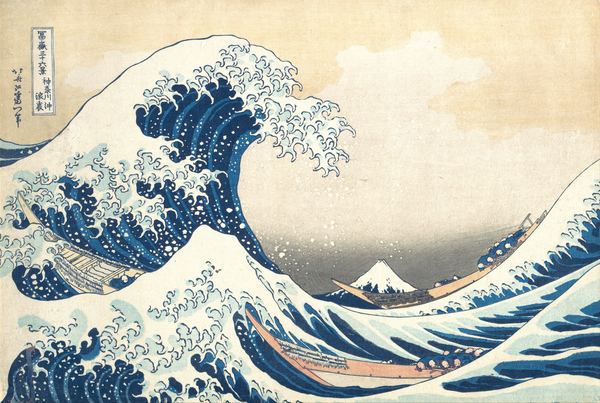
An old, restless, self-promoting genius starts publishing sketchbooks — the Hokusai Manga, fifteen volumes of everything he has ever looked at, from wrestlers to roof tiles to ghosts with long necks. Then the Thirty-six Views of Mount Fuji: Fuji as a constant, everything else as weather. The series leans on Prussian blue, a synthetic European pigment arriving through Nagasaki in the 1820s, which gives the sea a depth no Japanese blue had reached. The most famous sheet of all — the wave off Kanagawa — was printed in late 1831: three boats, thirty rowers, and a mountain that does not care. Roughly a hundred impressions survive; the series sold so well that Hokusai added ten more views.

Katsushika Hokusai · 30,000+ works claimed across his life · 30+ names

Hokusai, Under the Wave off Kanagawa, with claw-like foam and three boats of rowers, Mount Fuji small in the distance.
Hokusai, Under the Wave off Kanagawa, late 1831. Prussian blue, and a horizon dropped so far that the wave owns the sky.
1832–1843

Travel, and the crackdown that made it

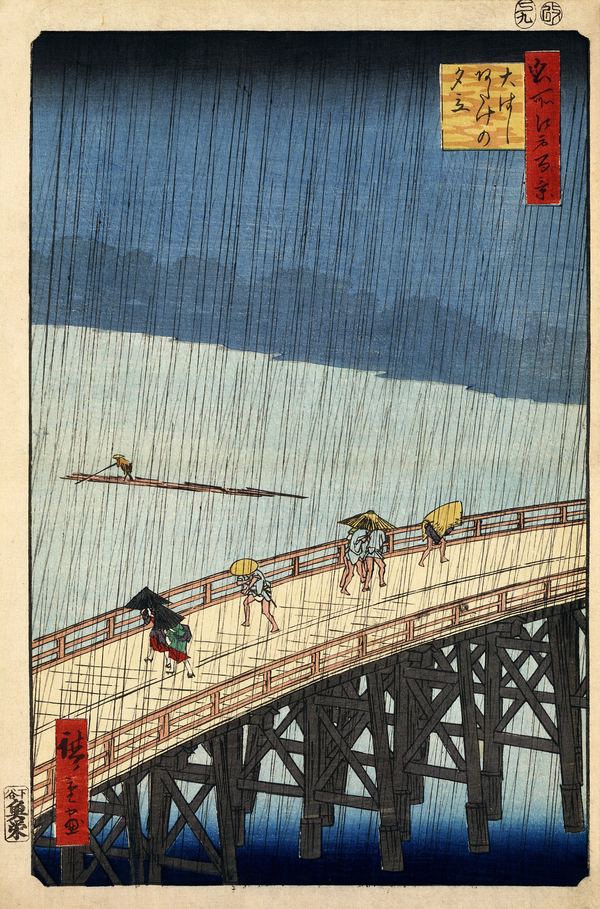
Hiroshige walks the Tōkaidō, the great road between Edo and Kyoto, and publishes fifty-three stations of rain, snow, tea-houses and post towns — a travel boom in print, cheap enough for the traveller who could not go. Then the Tenpō reforms of 1841–43 set out to suppress outward displays of luxury, which in practice means banning pictures of courtesans and actors. Publishers need a new subject. The landscape era becomes unavoidable, and the greatest print series in the genre's history are made under censorship.

Utagawa Hiroshige · Keisai Eisen

Hiroshige, a sudden summer shower over a bridge, drawn as a screen of fine diagonal rain lines over a dark sky.
Hiroshige, sudden shower over the Shin-Ōhashi bridge, 1857 — the rain drawn as a screen of lines over sky, water and people alike.
1840s–1858

Ghosts, warriors, and the last great series

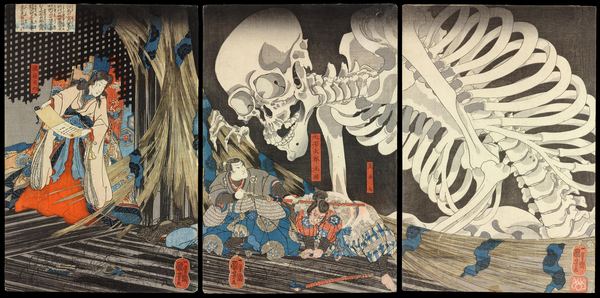
Utagawa Kuniyoshi turns the warrior print into something wilder — a princess summoning a skeleton taller than any building, a whale-sized catfish blamed for earthquakes, heroes whose tattoos became a style that is still being copied. Hiroshige, at the end of his life, makes the One Hundred Famous Views of Edo: a portrait of a city in rain, snow, plum blossom and fireworks, from a hundred points of view. Hokusai dies in 1849, complaining that he has not yet learned to draw.

Utagawa Kuniyoshi · Utagawa Kunisada · Utagawa Hiroshige

Kuniyoshi, a triptych in which a gigantic skeleton looms over a princess and two samurai.
Kuniyoshi, the witch Takiyasha and the skeleton spectre, c. 1844. Three sheets, one monster.
1853–1868

Ships in the bay, and a country turned inside out

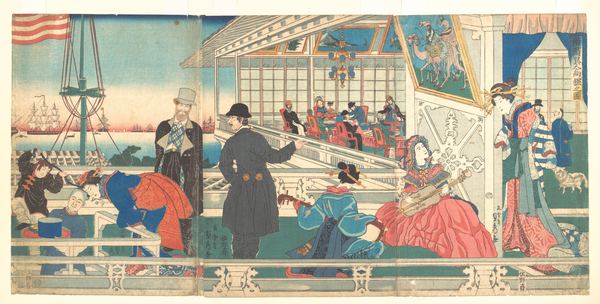
Commodore Perry's squadron arrives; the ports open; and the printers immediately invent a genre for what people are suddenly seeing in the street — Yokohama-e pictures of foreigners in their drawing rooms, with their whiskers and their strange hats. Then the shogunate falls. In 1868 the capital moves to Tokyo and the whole social order that bought these pictures disappears with it.

Utagawa Sadahide · Utagawa Yoshitora · Utagawa Yoshiiku

Sadahide, a triptych showing foreign merchants and their households in the open port of Yokohama.
Sadahide, the home of foreign merchants, Yokohama, 1861.
1870s–1900

Newsprint, and the last masters

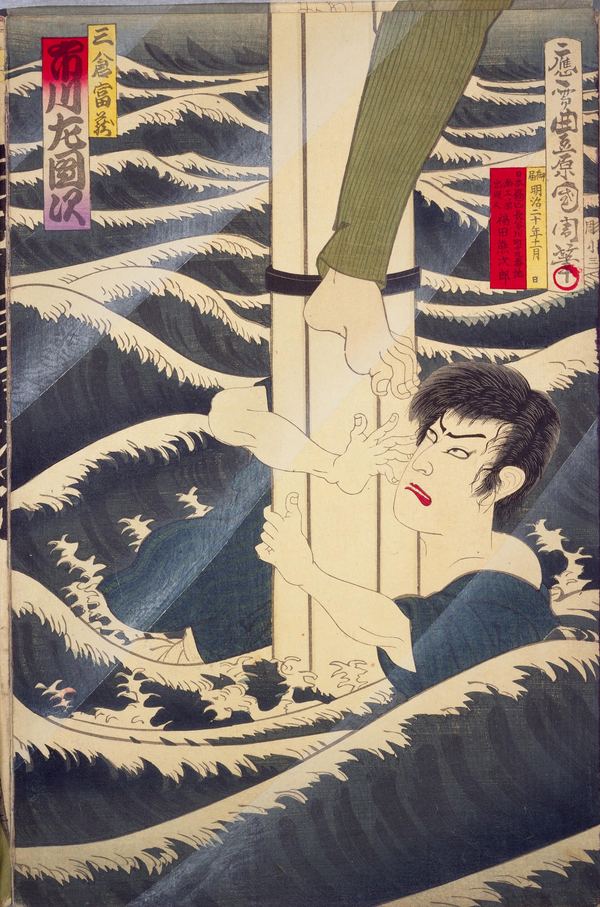
Photography takes the documentary work; newspapers take the news; and the print industry pivots to nishiki-e shinbun, paper equivalents of headlines — murders, steamship disasters, war. The first Sino-Japanese war of 1894–95 produces about 3,000 prints in nine months, bright and cheap against grey photographs. Three artists hold the line: Kunichika with the theatre, Yoshitoshi with ghosts and the moon, Kiyochika with a startling modern eye for gaslight, rain and empty streets — the last of them painting his city like an Impressionist who had never met one.

Toyohara Kunichika · Tsukioka Yoshitoshi · Kobayashi Kiyochika

Kunichika, a news print depicting the sinking of a steamship off Kishū.
Kunichika, 1887: a steamship lost off Kishū — the front page, printed in colour.
1915–1950

The revival: shin-hanga and sōsaku-hanga

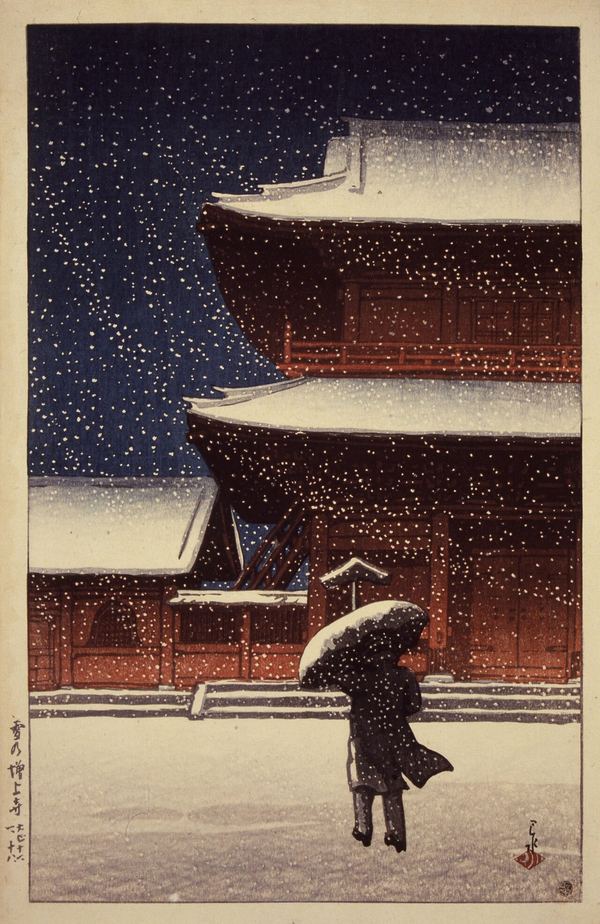
Two answers to the same question — what is a print for once it is no longer journalism? Shin-hanga keeps the old committee: an artist designs, specialists carve and print, a publisher sells nocturnes and snow to collectors abroad. Kawase Hasui's night scenes and Hashiguchi Goyō's intense, private portraits of women are made that way. Sōsaku-hanga rejects the committee entirely: one artist does everything, and the print becomes a statement rather than a product. Between them they carry the woodblock into the twentieth century — and both are looking over their shoulder at a tradition that had already ended.

Kawase Hasui · Hashiguchi Goyō · Watanabe Shōzaburō (publisher) · Onchi Kōshirō

Kawase Hasui, a snow scene at night at Zōjō-ji temple, printed in deep blue and white.
Kawase Hasui, snow at Zōjō-ji, 1922.
五

How to read a sheet

Signature · cartouche · seals · margins · state

A print carries its own paperwork, and the paperwork tells you who made it, who approved it, who sold it, and roughly when. Learn seven positions and you can date most ukiyo-e to within a decade from across a room — then look at the paper, because paper is where the money shows.

title series signature 印 kentō margin where a collector trimmed it 1 2 5 3 4 6 7
  1. 1Title cartouche. Usually upper right, often a small vertical rectangle in red or yellow. The colour alone is a dating aid: certain pigment combinations belong to certain decades.
  2. 2Series cartouche. Beside the title: which set this sheet belongs to. Publishers sold landscapes by the set — buy one station of the Tōkaidō, come back for fifty-two more.
  3. 3Signature. Names end in hitsu, "from the brush of". Artists changed names constantly — Hokusai used more than thirty — so the name dates the design almost as precisely as a copyright line.
  4. 4Publisher's seal. The hanmoto's mark, often a tiny diagram of a mountain, a leaf or a fish. He owned the blocks; his seal is the closest thing to a title page.
  5. 5Approval and date seals. Small circular or oval marks near the top: the censors' record that the design was permitted, and a date seal naming the month and year of the animal cycle. When prints were banned outright, this is where the paperwork gets interesting.
  6. 6Kentō registration marks. The right-angle corner mark and the bar beside it. Identical on every block in the set; a printer laid the damp sheet to them and hit the colours in the same place, impression after impression, until the blocks wore out.
  7. 7Margins. Often cut off by later collectors, framed to the image, or trimmed for binding into albums. A full, untrimmed margin with seals intact is a big part of why one impression is worth twenty times another.

The most important thing on the sheet is not printed on it: which impression you are holding. The first pulls are crisp, the mica sits high, the pink is still pink. Later pulls show a thickening line, a choked colour block, a blurred keyblock — and the beni has usually faded, because safflower is a fugitive pigment. Most surviving prints are not what they looked like on the day of sale.

Censorship, softly enforced, occasionally brutal

The shogunate policed pictures the way it policed everything: through approval, arbitrariness and occasional demonstration. The Kansei reforms from 1790 tightened standards on luxury and display. The Tenpō reforms of 1841–43 went further, suppressing outward luxury including the depiction of courtesans and actors — which is why the 1840s become the great age of landscape, not because artists lost interest in faces but because the faces were no longer legal.

The famous case is Utamaro's. Prints about the sixteenth-century ruler Toyotomi Hideyoshi — a name no Tokugawa regime was comfortable with — put him in manacles for fifty days. He died two years later. The lesson absorbed by every publisher in Edo: the safest possible subject is a mountain, a bridge and the rain.

What was not censored is a surprise to most modern readers. Shunga — erotic prints, made by nearly every artist in this page's cast, Harunobu and Utamaro included — circulated freely for two centuries, and only met serious suppression under Meiji-era morals. A government that policed pictures of actors left pictures of sex alone.

Two prints, same design, fifteen years apart

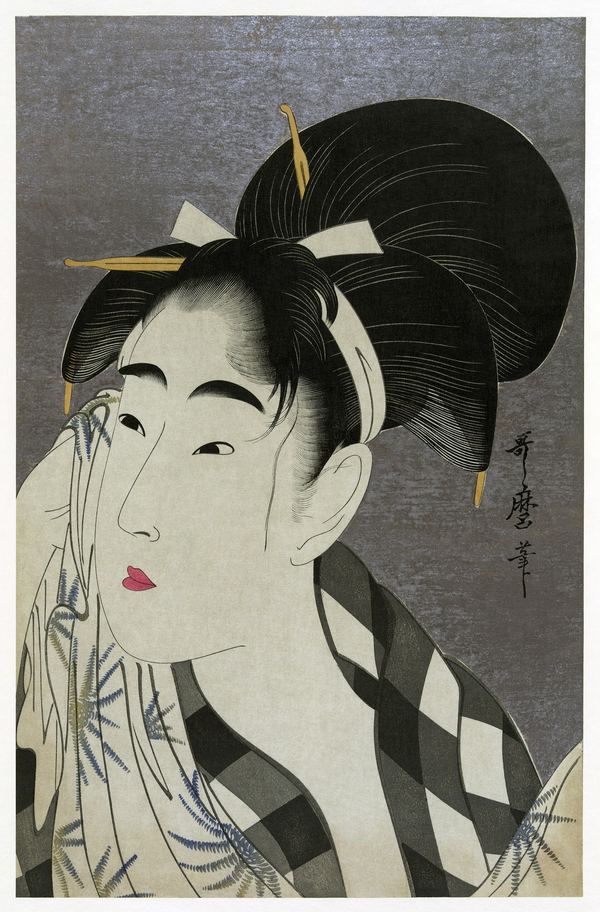
Utamaro, Woman Wiping Sweat: a head-and-shoulders portrait of a young woman pressing a cloth to her face.
plate 11Woman wiping sweat Design by Kitagawa Utamaro, 1798 · this impression printed 1918–23 · Library of Congress

Look at the Library of Congress record and you find something every collector has to know: the design is 1798, the sheet is early twentieth century. A century after Utamaro died, his blocks — or blocks freshly recut from his designs — were still being printed in Tokyo and sold as fine art. It is a perfectly good print of a great design, and it is not an early impression. The difference in value is roughly two orders of magnitude.

六

Look closer

Eight details, cropped from the plates at full resolution

Ukiyo-e is drawn to be read at arm's length and rewards being read at nose length. Every crop below is cut from the museum file above it — same file, same pixels, just nearer.

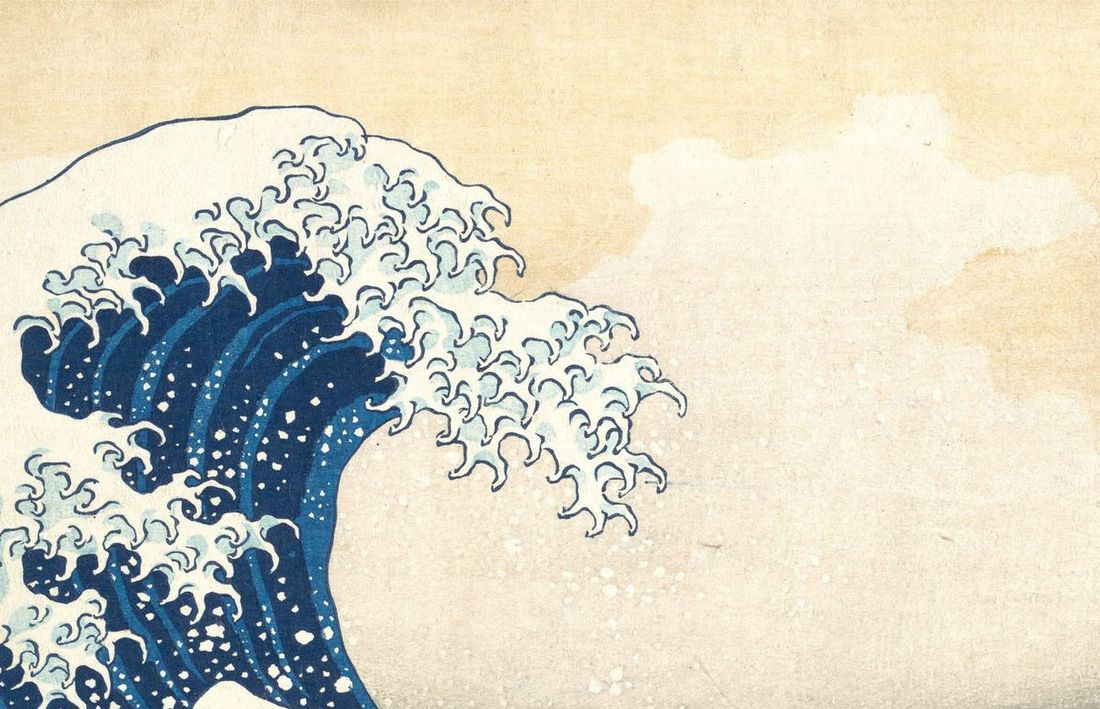
Detail of the crest of the Great Wave: foam breaking into clawed, hooked tendrils with three or four digits each, over deep indigo.
The claw. The famous foam is not drawn as a curl but as talons — hooked, three- and four-fingered, branching into the air. And the white is not white ink: it is bare paper, the block cut away so nothing printed there at all. Hokusai is drawing with absence.
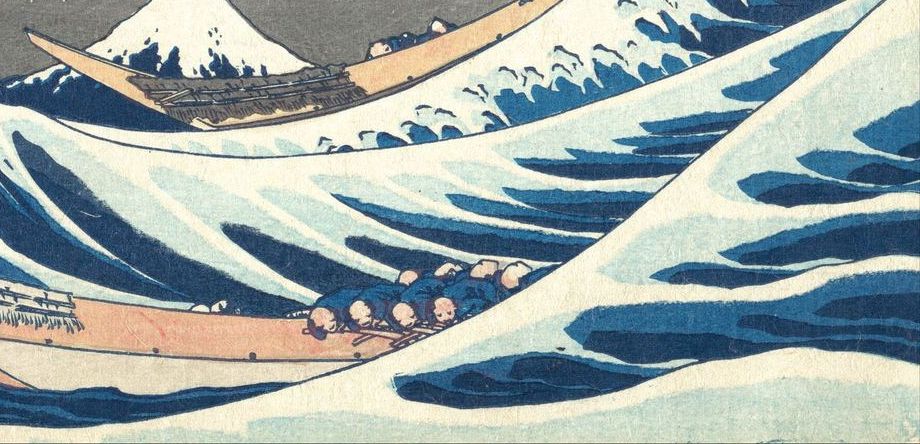
Detail of the Great Wave: three narrow cargo boats packed with rowers in blue-and-white garments, bent over their oars.
The rowers. Three oshiokuri-bune, fast fish-cargo boats, packed with rowers bent double, hands on oars, faces turned down and away. Nobody is heroic; everybody is working. The whole drama of the print depends on these tiny figures being legible from across a room.
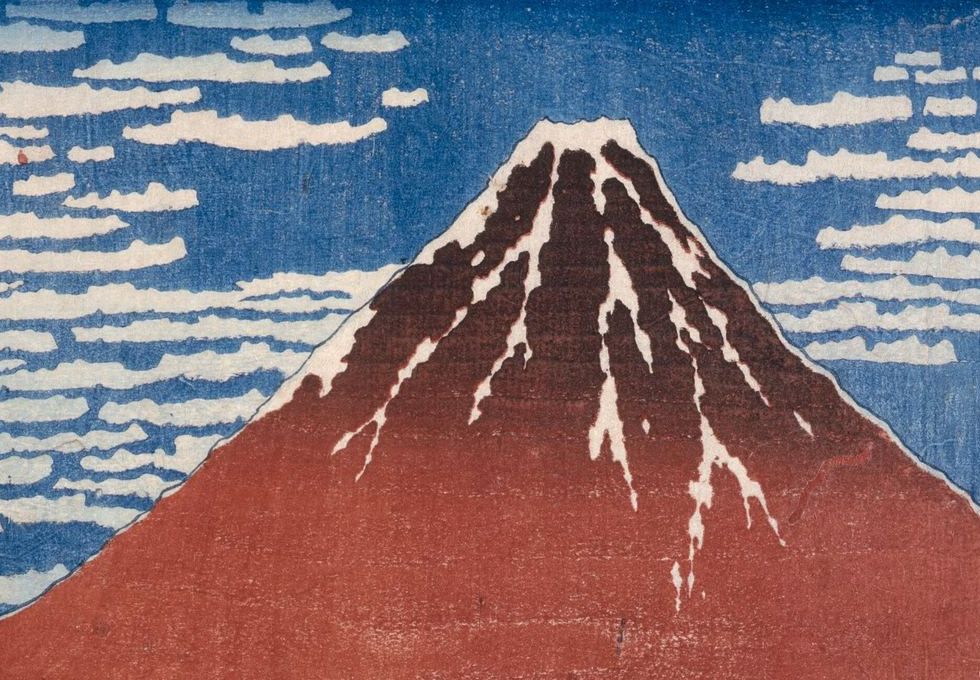
Detail of Red Fuji: a brick-red mountain with snow descending in jagged finger-like streaks, against a graded Prussian blue sky.
The snow. On Hokusai's red Fuji the snow does not sit on the summit like icing — it descends in jagged fingers, following every crease of the mountain. Cut on a block of its own, printed last, over the red: the white reads as cold precisely because the warm ground underneath it is still visible at the edges.
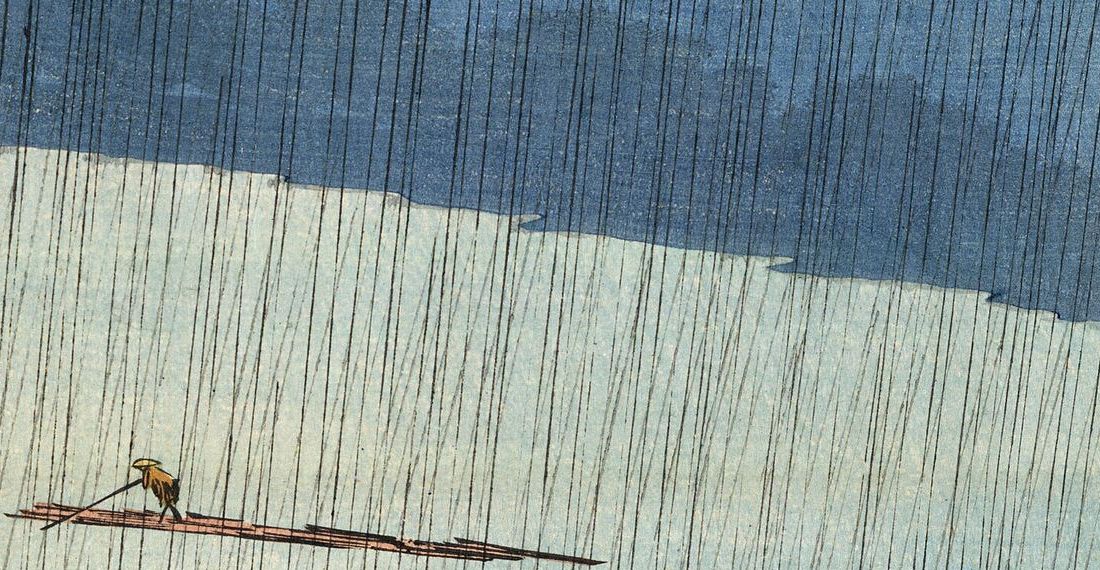
Detail of Hiroshige's rain: hairline slanted lines falling across a dark cloud band and paler sky, with title cartouches at the upper right.
The rain. One block, one set of hairlines, printed across sky, cloud, water, bridge and people alike — the print's single most economical decision. Against the dark cloud the lines nearly vanish; against the pale sky they read at once. Weather drawn as an even screen rather than a gesture.
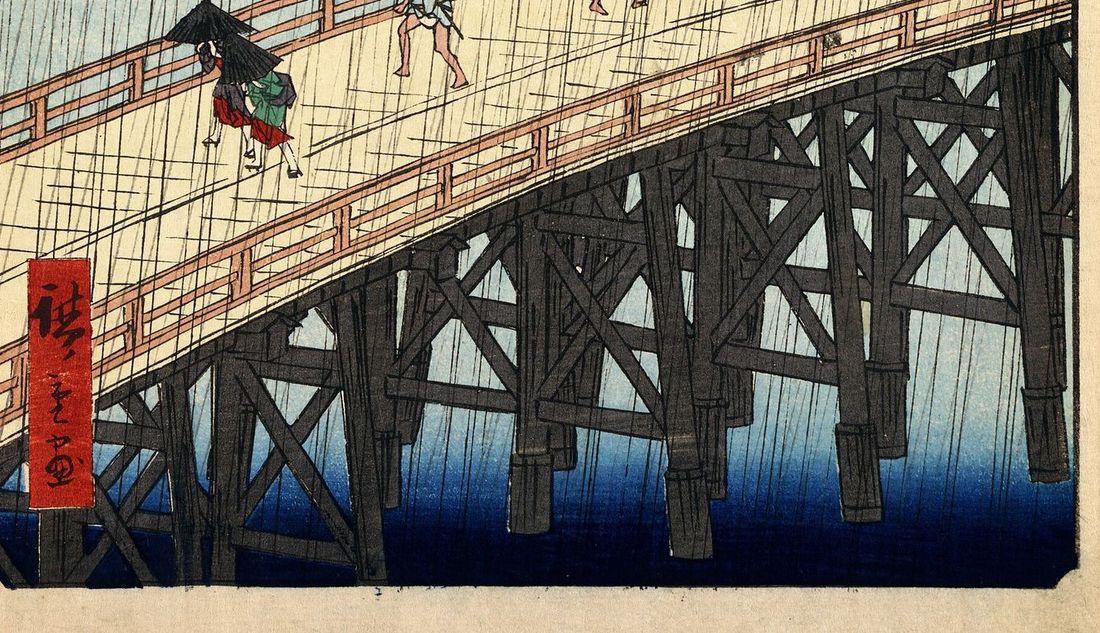
Detail of Hiroshige's bridge: figures crossing in the rain under umbrellas, the pale plank deck above a dark timber trestle.
The umbrella. Count the umbrellas — and note that each one is a different colour, printed from its own small block. Five hurried pedestrians, five umbrellas, one shared shower. The bridge is tilted so far up the frame that the horizon vanishes; nobody minds.
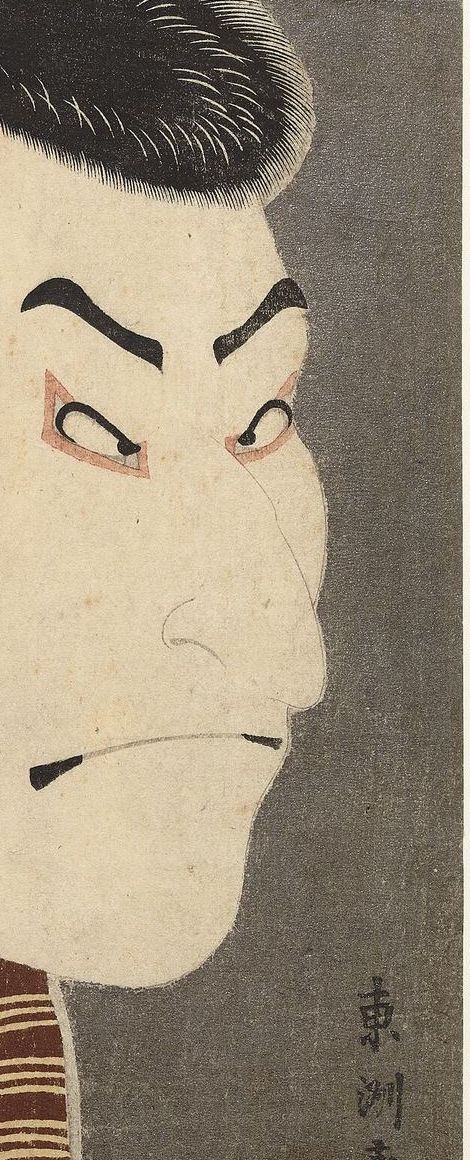
Detail of a Sharaku actor portrait: heavy brows angled into a scowl, eyes narrowed with reddened lids, thick black hair, against a speckled dark ground.
The scowl. Sharaku's eyebrows are two black wedges meeting in a knot; the eyes are narrowed with reddened lids, the jaw pushed forward. This is a portrait of an actor acting, and it declines to be charming. Note the ground behind the head: mottled, gritty, and matte in this impression — mica that was once meant to shimmer has darkened with age.
Detail of Utamaro's Three Beauties: a woman's face in near-profile with a high hairline, fine hairpins, and layered kimono collars.
The hairline. Utamaro's beauties are built from a dozen drawn strands against a solid mass of black, with the forehead drawn high and the eyebrows reduced to a smudge. Three heads stacked in a triangle, not one of them looking at another, in a space so empty it feels like silence.
Detail of Kiyonaga's bathhouse: a wooden transom carved with a pattern of waves and flying plovers above the bathers.
The transom. A tiny joke buried in an everyday scene: the bathhouse window is carved with waves and plovers, the sea brought indoors above a room full of water. This is the return on a print that cost less than dinner — a detail nobody asked for and somebody bothered to cut.
七

The wrapping paper that rewrote European art

Japonisme · 1856 – 1900

By the 1860s ukiyo-e was, in Japan, a dying trade on cheap paper. In Paris and London it was an explosion. The prints arrived as packing material and curiosities in the curiosity shops around the rue de Rivoli, and within thirty years they had changed how Western painters drew a face, framed a picture and cut a colour.

Around 1856 the French etcher Félix Bracquemond came across a volume of the Hokusai Manga at his printer's workshop and started showing it to everyone he knew. Shops like La Porte Chinoise sold Japanese imports and became salons in disguise — Whistler, Manet and Degas were regulars. In 1867 Parisians saw Japanese art formally for the first time when Japan took a pavilion at the World's Fair. In 1872 the critic Philippe Burty coined a word for the craze: japonisme.

What the painters took was not the subject matter, mostly, but the machinery: asymmetry, empty space, a high horizon, flat colour and a hard outline. Composition that put the important thing off-centre and let a third of the sheet stay blank.

Two stories about how the prints got there are told so often they have become folklore, and both are worth repeating as folklore: that Whistler found Japanese prints in a Chinese tearoom near London Bridge, and that Monet first encountered them used as wrapping paper in a Dutch spice shop. The reality was bales of objects and paper; the myth is that nobody in Europe knew what these pictures were worth — while in Edo they had been worth a bowl of noodles.

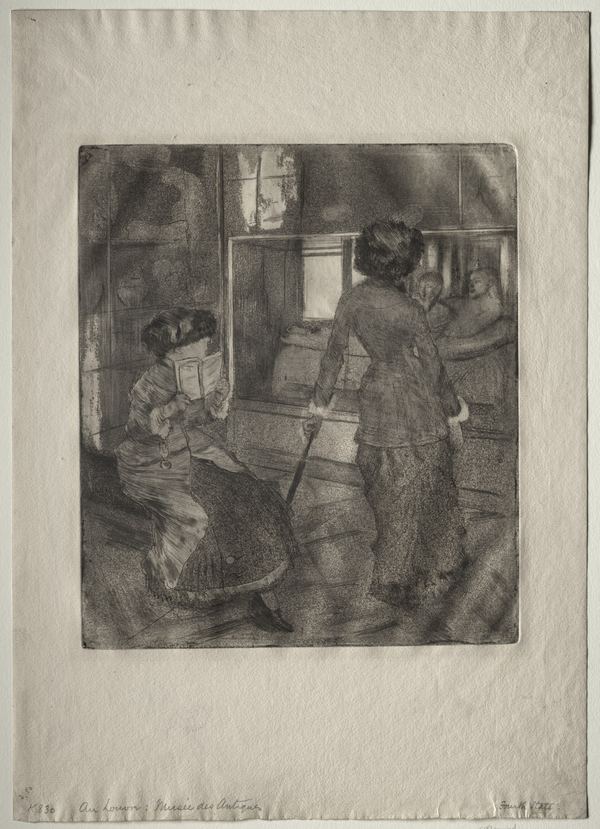
Degas took asymmetry and the elongated format and never once dressed a model in a kimono — his tall drypoint of Cassatt in the Louvre runs to page height and is mostly empty. Mary Cassatt saw a large ukiyo-e exhibition at the École des Beaux-Arts in 1890 and made ten colour drypoints in open imitation of it, flat colour and pattern included. Toulouse-Lautrec lifted the exaggerated expressions and flat colour of kabuki prints straight into posters. Gauguin abandoned lithography for Japanese woodcut technique. Van Gogh collected prints from 1885, organised an exhibition of them in Paris in 1887, and then did something almost nobody dares: he painted copies of Hiroshige, in oil, and signed them as his own translations.

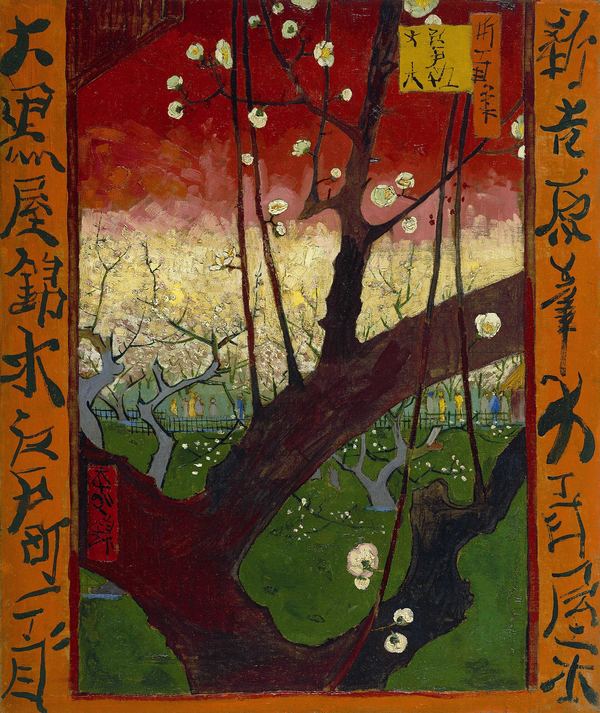
Van Gogh, Flowering Plum Orchard (after Hiroshige): a copy in oil of Hiroshige's print, with the frame filled by Japanese characters.
plate 29Flowering Plum Orchard (after Hiroshige)Vincent van Gogh · 1887 · oil on canvas, Van Gogh Museum

A Western painter copying a Japanese print, in the wrong medium, at the wrong scale, and adding calligraphy down the sides that he could not read but understood the look of. It is the whole relationship in one canvas: admiration, appropriation, and an attempt to make oil paint behave like a water-based woodblock.

Hiroshige's sudden shower print, the source Van Gogh copied as Bridge in the Rain.
plate 20Sudden Shower over Shin-ŌhashiUtagawa Hiroshige · 1857 · from One Hundred Famous Views of Edo

Van Gogh copied this one too, as Bridge in the Rain, and the rain lines are the point: thousands of hairlines cut into a single block, printed in one pass over everything. Western printmakers had presses and oil-based ink; the Japanese had a knife, a wet brush and patience.

Degas, Mary Cassatt at the Louvre: two women, one seated reading and one standing with a parasol, on a tall narrow sheet.
plate 28Mary Cassatt at the Louvre: The Etruscan GalleryEdgar Degas · 1879–80 · etching and drypoint, Cleveland Museum of Art (CC0)

Everything Japanese here is structural. The sheet is taller than the subject needs; the two women sit at the bottom of it and a wall of empty tone fills the rest; one is seen from behind. Nothing is dressed up as Japan — Degas took the format and left the costume.

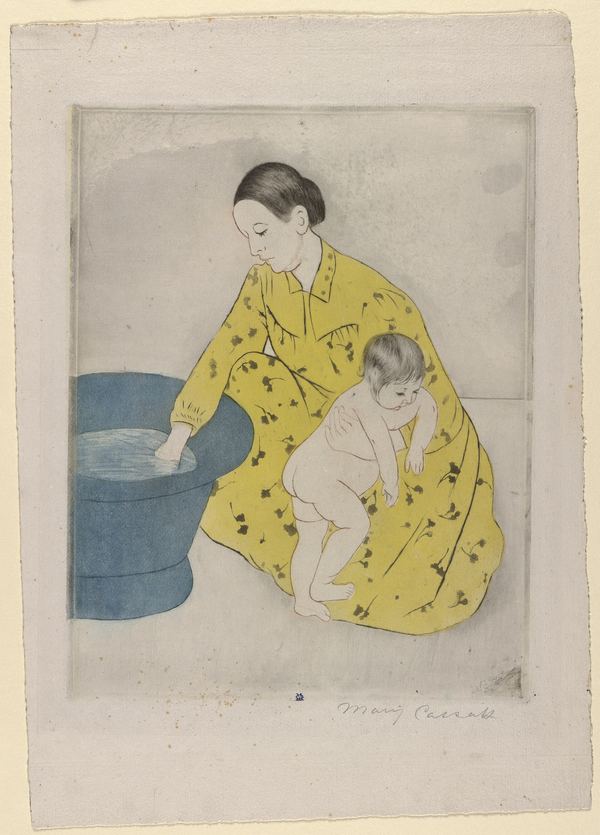
Cassatt, The Bath: a woman washing a small child, in flat yellow, blue and grey.
plate 30The BathMary Cassatt · 1890–91 · colour drypoint and aquatint, Cleveland Museum of Art (CC0)

One of the ten colour prints Cassatt made after seeing the large ukiyo-e exhibition in Paris in 1890. The palette is down to three or four flat areas, the water is three lines, the dress is pattern rather than drapery — and the subject is a woman washing a child, which is Utamaro's territory exactly.

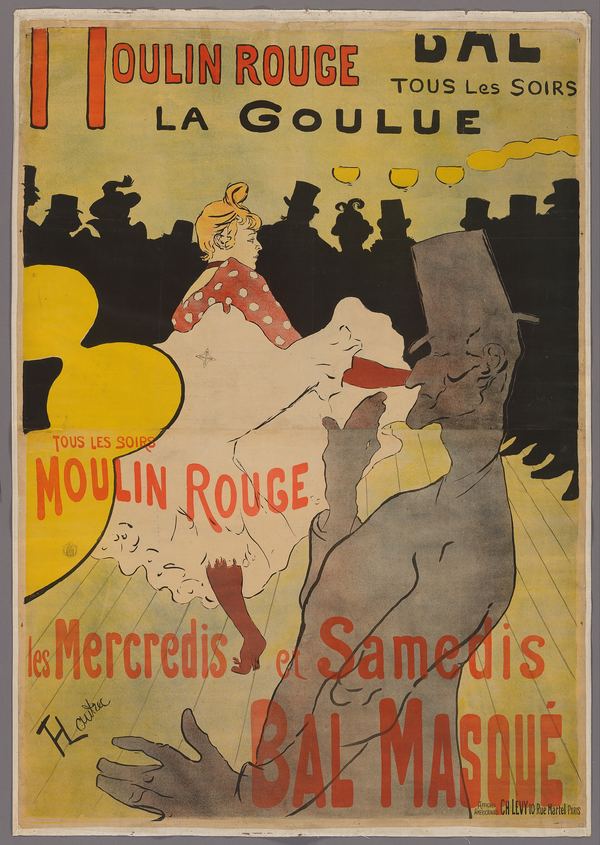
Lautrec's Moulin Rouge poster: a dancer in white, a grey figure in a top hat, a black crowd silhouette and a large red M.
plate 31Moulin Rouge: La GoulueHenri de Toulouse-Lautrec · 1891 · colour lithograph poster, Rijksmuseum (CC0)

The most direct translation of all. Five flat colours, a hard black contour round everything, the audience flattened into one black silhouette, and a foreground hand cropped by the frame — design moves lifted straight from actor prints and used to sell a cabaret.

八

Afterlife: a wave on the currency

The most reproduced image in the history of art is on a banknote

Hokusai's wave has been used and reused so hard that it has been called, by the Australian Broadcasting Corporation no less, possibly the most reproduced image in the history of all art. In 2024 it stopped being a metaphor for ubiquity and became one literally: the Bank of Japan put it on the back of the new ¥1,000 note.

¥1,000The note issued in 2024 carries Under the Great Wave off Kanagawa on its reverse. The Bank of Japan's own description calls it one of Hokusai's most famous works, "which is highly recognized and has influenced artists around the world."
≈100Impressions of the Great Wave thought to survive into this century, out of an unknown original print run — a survival rate that says everything about how these pictures were treated.
1814The year Hokusai began publishing his sketchbooks. The word for them — manga — is now the name of a global industry, and it started as "random sketches".

What actually survived of the method

The commercial form died in the 1890s; the visual grammar did not. Flat planes of colour with a hard inked edge, a subject in profile against an empty ground, a horizon dropped to make the sky do the work — you are looking at those decisions all the time, in manga panels, in anime backgrounds, in poster design, in tattoo shops, in the vinyl and sticker economy, in Takashi Murakami's superflat surfaces. Serial repetition, the same face printed again and again with one variable changed, is pop art's whole method, and ukiyo-e industrialised it a century and a half earlier.

Part of the reason ukiyo-e travelled so well is that most of it has no copyright problem at all. The artists died long ago, the blocks were reprints and the impressions were sold by the bale — which is why a page like this can show thirty-two first-rate plates without asking anyone's permission.

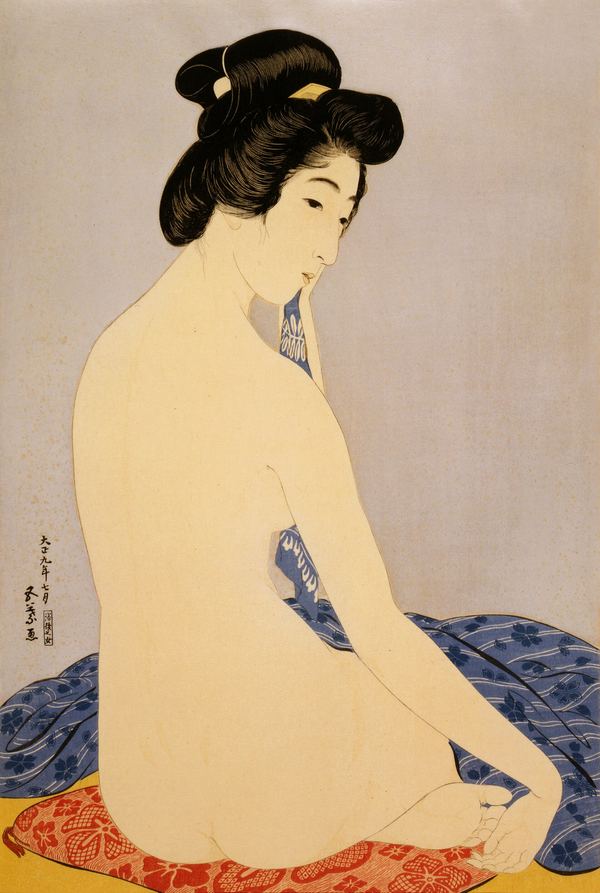
Hashiguchi Goyō, Woman after Bath: a full-length figure seen from behind, drying herself, in pale skin tones and a patterned robe.
plate 32Woman after the bathHashiguchi Goyō · 1920 · woodblock print, Library of Congress

A hundred and twenty years after Utamaro, the same subject and a completely different temperature: Goyō's woman is intimate, unobserved, and printed with a realism Utamaro would have considered beside the point. Goyō died at 41 having made barely a dozen prints, and the tradition he was reinventing died with him.

Where the plates on this page live

Part of the pleasure of ukiyo-e is that the world's public collections opened their files. Every image here came out of an open-access programme — nine of them (Met, Cleveland, Honolulu, Rijksmuseum, Library of Congress, National Diet Library, Hood Museum at Dartmouth, Waseda's theatre archive, Soka Art Museum) plus Google Arts & Culture's digitisation of others. If you want to see it in the flesh:

  • The Metropolitan Museum of Art, New York
  • Museum of Fine Arts, Boston
  • Art Institute of Chicago
  • Rijksmuseum, Amsterdam
  • The British Museum, London
  • Tokyo National Museum · the Ōta Memorial Museum of Art, Tokyo
  • Honolulu Museum of Art · Cleveland Museum of Art
  • Edo-Tokyo Museum — a reconstruction, in a city that was rebuilt twice

A fair warning for the visitor: the colours are quieter in person. The pinks have gone pale, the mica has dulled, the paper has yellowed to the tone that now reads to us as "old Japanese print". What you are seeing in a museum is not what Edo saw at the stall — and the digital plates are usually sharper, brighter photographs of sheets that are, physically, tired.

九

The plates

Thirty-five works · click any one to see it whole

The full catalogue behind this page, in rough chronological order, with the collection and licence for each. Filter it by what you want to look at, or hover any plate for a loupe view of the block. Thumbnails sit in uniform frames, so open any plate to see its true proportions.

十

A small dictionary

The words the trade used

ukiyo-e 浮世絵
Pictures of the floating world: the transient, pleasure-seeking present as a subject for art.
bijin-ga 美人画
Pictures of beautiful women — the genre's oldest and longest-running subject.
yakusha-e 役者絵
Actor prints: kabuki stars drawn as the character they were playing.
ōkubi-e 大首絵
"Large-headed picture": bust portraits that make the face, not the costume, the subject.
musha-e 武者絵
Warrior prints: heroes from history, legend and popular serial fiction, often in triptychs.
kachō-ga 花鳥画
Birds and flowers: nature studies with no narrative and no people.
meisho-e 名所絵
Pictures of famous places — the postcard, before photography.
uki-e 浮絵
"Floating pictures": prints built on European one-point perspective.
nishiki-e 錦絵
"Brocade prints": full-colour printing from many blocks, standard after 1765.
aizuri-e 藍摺絵
Prints in blue only — sometimes a deliberate aesthetic, sometimes a censorship-era economy.
benizuri-e 紅摺絵
Two- and three-colour prints of the 1740s–60s, mostly safflower pink and green.
sumizuri-e 墨摺絵
Black-ink prints: the earliest mass form, before colour printing at all.
urushi-e 漆絵
Prints with a glossy lacquer-black finish, colour applied by hand.
kentō 見当
Registration marks cut identically into every block, so the colours land in line.
hanshita-e 版下絵
The finished drawing, pasted face-down on the block for cutting.
baren 馬連
The printer's rubbing pad: paper disc, bamboo-sheath wrap, twisted cord handle.
bokashi 暈し
Graded colour across a single printed area, wiped into the block before printing.
karazuri 空摺
Blind embossing with an uninked block — decoration felt rather than seen.
kira-zuri 雲母摺
Mica dusted onto the print for a glittering ground behind a figure.
surimono 摺物
Privately commissioned prints for poetry clubs and New Year gifts — the luxury end: extra blocks, embossing, gold.
hashira-e 柱絵
Pillar print: exceptionally tall and narrow, hung on a wooden post.
shin-hanga 新版画
Twentieth-century revival keeping the old division of labour, selling scenery abroad.
sōsaku-hanga 創作版画
"Creative prints": one artist designing, cutting and printing their own work.
shunga 春画
Erotic prints, made by nearly every major artist, tolerated for two centuries.
namazu-e 鯰絵
Catfish prints: earthquake broadsides blaming the giant catfish said to be pinned under the Kashima stone.
yokohama-e 横浜絵
Prints of the newly arrived foreigners and their strange possessions.
附

Sources, credits and how this was made

Read the receipts

Everything factual here can be traced to the sources below. Where a claim is contested, traditional, or an anecdote that is repeated more often than it is verified, it is marked as such in the text.

Principal sources

  • Wikipedia: Ukiyo-e, Woodblock printing in Japan, Nishiki-e, Japonisme, The Great Wave off Kanagawa, Hokusai, Hiroshige, Kitagawa Utamaro, Suzuki Harunobu, Tōshūsai Sharaku — the backbone for dates, prices, print runs and the censorship timeline.
  • The Metropolitan Museum of Art, Heilbrunn Timeline of Art History: “Woodblock Prints in the Ukiyo-e Style” (Dept. of Asian Art, 2003) for the four-part division of labour, the cherry block, the kentō system, up to twenty blocks and mulberry-bark paper; “Japonisme” (Colta Ives, 2004) for Bracquemond, the 1867 pavilion, Degas, Cassatt's ten etchings and the Whistler/Monet anecdotes; “Art of the Edo Period” for the social background.
  • Bank of Japan, New Bank of Japan Notes Special Website — the design and wording for the 2024 ¥1,000 note.
  • Quoted in the text: Asai Ryōi, Ukiyo Monogatari (c. 1661), in the standard English translation; Hokusai's late-life statement on drawing as recorded by Gian Carlo Calza (2003); Ōta Nanpo's report on why Sharaku's realism failed with the public.
  • Museum catalogue records for the individual plates (Met, Cleveland, Honolulu, Rijksmuseum, Library of Congress, National Diet Library, Hood Museum, Waseda, Soka) — these supplied the dates, media descriptions and, crucially, the honesty about later impressions.
Editorial notes

The diagram of the press sequence in section three is drawn by me — an illustration of how the layers stack, not a museum plate and not a reconstruction of a specific print. It is labelled as a schematic on the page itself, where it sits.

The detail crops in section six are cut from the same downloaded museum files as the plates elsewhere on the page, with no retouching beyond scaling and JPEG compression. Colours are as the institution published them; impressions differ, and a print at the Met genuinely does not look identical to the same design at the Library of Congress.

Attention was paid to attributions. Where a Commons file's own description contradicted its title or its artist's dates — one theatre interior, one object photographed as a baren that turned out to be a Western ink roller — the file was checked, corrected in the caption, or dropped. Fifteen plates in this catalogue were visually inspected and described before their captions were written.

Where the plate licenses require attribution (CC BY-SA and CC0 items), the attribution is in the credit line beneath each plate and in the full credit table below.

Plate-by-plate credits

01 Beauty Looking Back
Hishikawa Moronobu · late 17th century · Hanging scroll, ink and colour on silk
Tokyo National Museum (via Google Arts & Culture)Public domain
02 The actor Fujimura Handayū II
Torii Kiyonobu I · late 1710s · Woodblock print with colour applied by hand (hosoban)
Honolulu Museum of ArtCC0
03 Lovers walking in the snow (crow and heron)
Suzuki Harunobu · c. 1765–70 · Woodblock print with blind embossing (karazuri)
via Wikimedia CommonsPublic domain
04 The actor Ichikawa Raizō II as Soga no Gorō
Katsukawa Shunshō · mid-1770s · Woodblock print (hosoban)
Cleveland Museum of ArtCC0
05 The theatre district at dawn on opening day
Utagawa Toyoharu · 1770s · Woodblock print (uki-e, European perspective)
The Metropolitan Museum of ArtPublic domain
06 Women at the bathhouse
Torii Kiyonaga · after 1780 · Diptych of woodblock prints, two sheets joined
via Wikimedia CommonsPublic domain
07 Enjoying the evening cool at Nakasu
Torii Kiyonaga · c. 1782–83 · Woodblock print
The Metropolitan Museum of ArtCC0
08 Courtesans and their attendants
Hosoda Eishi · c. 1780s–90s · Woodblock print
The Metropolitan Museum of ArtCC0
09 Three Beauties of the Present Day
Kitagawa Utamaro · c. 1793 · Woodblock print (ōkubi-e)
via Google Arts & CulturePublic domain
10 Ōtani Oniji III as Yakko Edobei
Tōshūsai Sharaku · 1794 · Woodblock print; ink, colour and mica on paper
Tokyo National MuseumPublic domain
11 Woman wiping sweat
Kitagawa Utamaro · design 1798; this impression printed 1918–23 · Woodblock print
Library of CongressPublic domain
12 Sawamura Gennosuke as Satsuma Gengobei
Utagawa Toyokuni I · c. 1805 · Woodblock print
Cleveland Museum of ArtCC0
13 A page from the Hokusai Manga, volume 6
Katsushika Hokusai · from 1814 (fifteen volumes to 1878) · Woodblock-printed book page
via Wikimedia CommonsPublic domain
14 Under the Wave off Kanagawa
Katsushika Hokusai · late 1831 · Woodblock print; ink and colour on paper (ōban)
The Metropolitan Museum of ArtPublic domain
15 Fine Wind, Clear Morning
Katsushika Hokusai · c. 1830–32 · Woodblock print
via Google Arts & CulturePublic domain
16 Kajikazawa in Kai Province
Katsushika Hokusai · c. 1830 · Woodblock print
via Wikimedia CommonsPublic domain
17 Night Snow at Kambara
Utagawa Hiroshige · 1832–34 · Woodblock print
Hood Museum of Art, Dartmouth CollegePublic domain
18 A woman with a box, at Okitsu
Keisai Eisen · 1830 · Woodblock print
RijksmuseumCC0
19 The Kinryūsan Temple at Asakusa
Utagawa Hiroshige · 1856 · Woodblock print
The Metropolitan Museum of ArtCC0
20 Sudden Shower over Shin-Ōhashi Bridge
Utagawa Hiroshige · 1857 · Woodblock print (nishiki-e)
via Wikimedia CommonsPublic domain
21 The witch Takiyasha and the skeleton spectre
Utagawa Kuniyoshi · c. 1844 · Triptych of woodblock prints, three sheets joined
via Wikimedia CommonsPublic domain
22 Kabuki actor
Utagawa Kunisada (Toyokuni III) · 1858 · Woodblock print
via Google Arts & CulturePublic domain
23 Crowds praying at the Kaname-ishi rock
anonymous · c. 1855 · Woodblock-printed broadsheet
via Google Arts & CultureNo restrictions
24 The home of foreign merchants, Yokohama
Utagawa Sadahide · 1861 · Triptych of woodblock prints
The Metropolitan Museum of ArtPublic domain
25 The Sumida River at night
Kobayashi Kiyochika · 1881 · Woodblock print
Honolulu Museum of Art (Michener collection)Public domain
26 Kitayama Moon
Tsukioka Yoshitoshi · 1886 · Woodblock print with embossing and lacquer highlights
private collection, via Wikimedia CommonsPublic domain
27 The steamship lost off Kishū
Toyohara Kunichika · 1887 · Woodblock print
National Diet Library Digital CollectionsPublic domain
28 Mary Cassatt at the Louvre: The Etruscan Gallery
Edgar Degas · 1879–80 · Etching and drypoint
Cleveland Museum of ArtCC0
29 Flowering Plum Orchard (after Hiroshige)
Vincent van Gogh · 1887 · Oil on canvas
Van Gogh Museum (via Google Arts & Culture)Public domain
30 The Bath
Mary Cassatt · 1890–91 · Colour drypoint and aquatint printed from several plates
Cleveland Museum of ArtCC0
31 Moulin Rouge: La Goulue
Henri de Toulouse-Lautrec · 1891 · Colour lithograph poster
RijksmuseumCC0
32 Woman after the bath
Hashiguchi Goyō · 1920 · Woodblock print (shin-hanga)
Library of CongressPublic domain
33 Snow at Zōjō-ji
Kawase Hasui · 1922 · Woodblock print (shin-hanga)
via Wikimedia CommonsPublic domain
34 A baren
photograph by Tiouraren (Y.-C. Tsai) · 2010s · Photograph, CC BY-SA 4.0
Soka Art Museum exhibition, via Wikimedia CommonsCC BY-SA 4.0
35 Papermaking at Echizen
photograph by TR15336300101 · 2019 · Photograph, CC BY-SA 4.0
via Wikimedia Commons (Udatasu craft hall, Fukui)CC BY-SA 4.0